
Home » Shincheonji » How to Leave Shincheonji: The First Steps
How to Leave Shincheonji: The First Steps
Fact Checked by Bible Vaccine Center Editorial Team and
-
Written by Chris Vishoot
- Last Updated
On This Page
Leaving Shincheonji
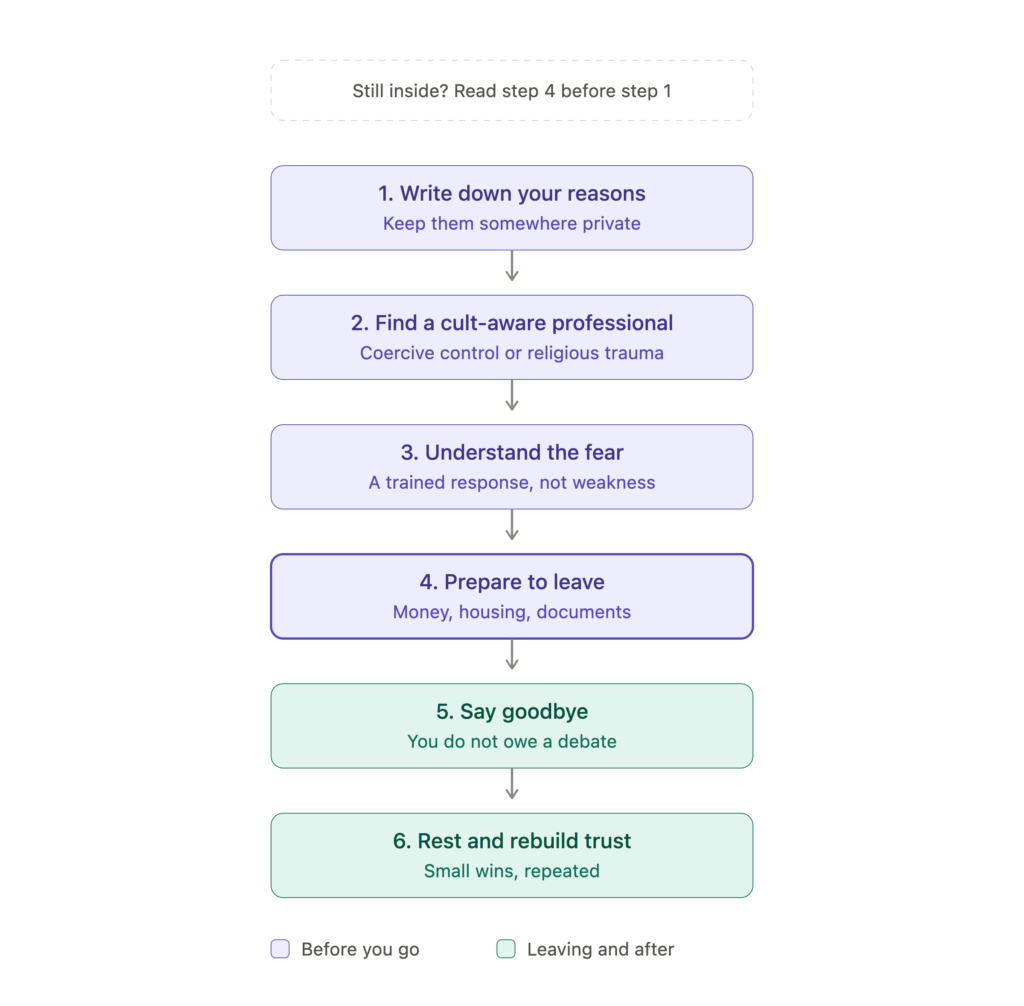
So, you finally realized the truth about Shincheonji, and that it wasn’t what you expected or initially thought it was going to be.
That’s okay. I was once in your shoes as well, and I felt overwhelmed when I realized that Shincheonji wasn’t the place of truth, or had the highest teachings.
In this article, I am going to help create some steps for you on how to leave Shincheonji, as a former member who had to experience the same thing as you, but alone.
After leaving SCJ, and having to rebuild my life, I told myself that I wanted to build out a community so that nobody else had to do it alone, and here are some of the steps that I took.
A note on what this article covers. This is the practical and emotional side of leaving — the decision, your safety, your finances, and your exit. It is not the doctrinal side. If you want to work through the teachings themselves, read Shincheonji Examination. You do not have to do both at once, and plenty of people are not ready to open a Bible for a while after leaving. That is normal and it is not a failure.
If you are still inside, read Step 4 before you act on Step 1. Some of what follows is safe only once you are out.
Start here
Step 1 - Write down the reasons why you are leaving
When it comes to leaving, the first step is to write down the reason why you are leaving. For me, it was because of the set of changes to Revelation 7 that happened during the COVID great “tribulation”.
Whenever I had any doubts, I would always return to my notes that were hand written. I strongly recommend that you also hand write the reasons why you are leaving. Whether it’s issues with the prophecy and fulfillment of SCJ, or because of the doctrinal issues of SCJ, or because you are burned out and exhausted, it doesn’t matter. What matters is that how you are feeling today is valid, and despite SCJ’s best efforts to try to belittle or spiritually abuse you, it’s okay to be human.
One caution before you start writing. If you live with SCJ members, or in a center house or commune, think carefully about where those notes live. A notebook found by a roommate can end your timeline before you have chosen it. Keep them somewhere genuinely private, or somewhere outside the house entirely, whether it’s a locked drawer at work, a car, a friend’s place. If you write them digitally instead, do it in an account no one in SCJ has ever had the password to, and not in a shared drive or a Telegram chat with yourself.
Changes in the Doctrines of Shincheonji
- Where and who are the 144,000 since the Great Tribulation began?
- Why did the identity of the Beast of the Earth change?
- Why did the Great Tribulation affect SCJ when originally it wasn't supposed to?
- What happens if Lee Man-hee dies?
- Why did almost all of the original leaders of SCJ leave?
- Why is SCJ still using the Wisdom of Hiding?
Free Resource
Discover More Doctrinal Issues and Failed Prophecies
The link below goes into more discrepancies with the doctrinal issue of Shincheonji, alongside the fulfillment issues as well.
Building your support
Step 2 - Find a professional who understands cults or coercive control
The next thing to do is to find a professional mental health therapist who can assist you. Look specifically for someone with training in cults, high-demand groups, coercive control, or religious trauma. A general therapist with no background in this will often not understand what you are describing, and having to explain the whole structure of SCJ from scratch is exhausting when you are already depleted.
If cost is the barrier right now, say so when you call. Many practices have sliding scales, and it is a normal question to ask.
And in the meantime — I am not a professional therapist, but I am willing to jump on a Zoom call and talk, because it helps to have someone to speak with and hear their voice. Think of that as a bridge to professional support rather than a replacement for it. To reach me, or to find others who have been through this, come through the Bible Vaccine Contact rather than messaging me directly; that way there is a team behind it and you are not depending on one person’s schedule.
Freedom of Mind
FreedomOfMind.com — led by Steve Hassan, who was himself recruited into another Korean group (the Unification Church), and has a deep understanding of not only Korean groups, but also how cults in general indoctrinate you and destroy your identity. He is arguably one of the best resources out there when it comes to understanding how cult indoctrination works, and also how to recover from a high control group.
Chani Getter
Chani Getter — she was my professional therapist during the time period when I was preparing to leave Shincheonji. She helped me not only make a plan on how to leave, but also prepared me emotionally on what to expect, and she was a stable pillar for me when it came to my panic episodes. (Note: licensing and availability vary by location, so check whether she is currently taking clients and can work with someone in your state or country.)
The Olive Leaf Network
The Olive Leaf Network — for readers in Australia and New Zealand. They support leavers of high-demand religious groups and can connect you with counselling, community, and referrals. Australia: au.oliveleaf.network. They are a signposting and referral organization rather than a direct-aid one, so treat them as your guide to local services rather than as the service itself.
ICSA and People Leave Cults
ICSA and People Leave Cults — for therapist referrals and psychoeducation in the wider English-speaking world.
Step 3 - Understand how cult mind control works, especially phobia indoctrination
The best books on this topic are Combating Cult Mind Control and Freedom of Mind, both by Steve Hassan.
Both books helped me realize how SCJ systematically indoctrinated me, and how they introduced “phobia” indoctrination into my everyday life, causing me to be afraid of irrational things and thoughts.
For example, thinking that I was “betraying God” because I no longer believed the testimony of Lee Man-hee is an example of an irrational fear that was installed, not one I arrived at by reasoning.
In order to counter this fear, some theology helps. I went into detail on whether there is a “Promised Pastor of the New Testament”, and showed that SCJ isn’t faithful to the Bible, but instead relies on Lee Man-hee in order to have the “correct” understanding, even where SCJ’s interpretation contradicts the Bible.
I also made a video on [how SCJ introduces phobia indoctrination within their Bible studies]. Pair that with the fact that, as a full time member, it would be repeated and ingrained into you that leaving meant going to hell forever, and it makes sense that this fear takes a while to lose its grip. It is not a weakness. It is a trained response, and trained responses fade with time and evidence.
Two things helped me personally.
The Parable of the Prodigal Son
While SCJ may change its position every other day on whether a person can repent and turn things around with God, the picture Jesus gives is a father who sees his son while he is still a long way off and runs to him. There is no probation period, no re-registration, no proving yourself first. And notice something else: SCJ trained you to believe every parable is a coded message that requires a key. This one means exactly what it says.
When the Fear becomes Physical
The second is grounding, for when the fear becomes physical. When you are having what appears to be a panic attack, or you feel as though you are re-entering a memory of SCJ and it makes you feel uncomfortable, what helped me was grounding myself in the present. I first practiced box breathing, and then reminded myself where I was by touching my physical surroundings — a wall, a chair, the floor. Naming things out loud helps too. The point is to give your body evidence that you are here, now, and not there.
Before you go
Step 4 - Preparing to leave: money, housing, and logistics
Each person is different and has a different circumstance. Some people are living on their own, and others are living with current SCJ members. Work out which of the following actually apply to you and ignore the rest.
Why quiet is the recommendation. You may want to leave loudly, and there may come a time for that. But quiet exits attract less pursuit, and they let you get materially settled before the emotional crash arrives. If you want to speak publicly later, do it once you are safe and stable — not as the exit itself.
Money
Recurring Giving
Shared accounts
Money owed or held
Money owed or held. Anything you lent, anything held “for the church,” anything you contributed toward a shared lease or shared property.
Your income
Your income. This is the one that determines your entire timeline. If your job, your clients, or your hours run through an SCJ member or an SCJ-connected business, then leaving costs your income and your housing at the same moment. Line up other work, or at least a financial cushion, before you go. This is not a lack of faith or courage. It is the difference between leaving once and having to go back.
Your documents
Your documents. Passport, ID, birth certificate, bank cards, immigration paperwork. Get them into your own possession early.
Digital Footprints
Records
Screenshot or export anything you may want later — your own records, study materials, message threads — before you leave. Once you are removed from group chats and shared drives, you will not get back in.
Passwords
Change passwords on any account a member has ever had access to, and turn on two-factor authentication.
Group Chats
Leave the group chats last, not first. Leaving a chat is a public signal.
Property and Housing
If you keep belongings at a center house or with members, move them out gradually and unremarkably rather than in one conspicuous trip.
If you are living with a current SCJ member, or in one of their communes, you need to research where you are going to live before you go. SCJ will most likely try to pressure you into returning, or may remove you from housing entirely and leave you with nowhere to go.
Reaching out to family, read this first. If your family is outside of SCJ, they are usually your best first call. Explain what happened and that you need help leaving a high-control group.
But if your family is inside SCJ, a parent, a sibling, a spouse, do not start there. Telling them puts them in a position where reporting you is the compliant thing to do, and it gives the group advance notice of your plans. The same applies to any member you are close to and worried about. As hard as it is, get yourself out first. You will be much more use to them from outside.
If family is not an option, tell one trusted person outside the group what you are doing and where you will be, before you do it.
Where to get help with housing and money
None of the resources below are cult-specific, and that is fine — you do not need them to be. What matters is what you say when you contact them. The words that get help are “I have no money and nowhere to stay,” not “I just left a religious group.” Frame it as a housing and financial emergency, because that is exactly what it is, and that is the category these services are built to handle.
- United States — 211.org, or dial 2-1-1. Rent assistance, utilities, food, emergency shelter, referrals.
- Canada — 211.ca, or dial 2-1-1. Free and confidential, available in over 150 languages.
- United Kingdom — Shelter for housing emergencies, Turn2us for grants and benefits you may not know you qualify for, and Citizens Advice for general guidance.
- Australia — Ask Izzy. Free and anonymous, covering housing, food, money help and counselling. On Telstra and Vodafone it works with no credit or wifi.
- New Zealand — Family Services Directory for accommodation, foodbanks, and free financial mentors. For someone to talk to, call or text 1737.
- South Korea — 129, the Ministry of Health and Welfare counselling centre. Free nationwide, with emergency welfare support staffed 24 hours. KakaoTalk chat counselling is available, which is far less exposing than a phone call if you live with members. From outside Korea: 8231-389-7000.
Also worth trying, wherever you are: local churches often have discretionary benevolence funds with no application process at all, and legal aid can help if there is a lease, a contract, or money you may have a claim to.
Step 5 - Saying Goodbye
This is one of the most difficult steps, because you are saying goodbye to more than a building and a schedule.
You do not owe anyone a debate. You will be asked why. You do not have to give doctrinal reasons, you do not have to win the argument, and you do not have to convince anyone that you are right. A short, boring, unarguable answer works far better than a good one: I’ve decided to step away. I’m not going to discuss it. Repeat as needed. Every reason you give is something they have been trained to answer, and the conversation exists to keep you in the room.
Expect contact, and know what it is. The calls and visits will come, they will escalate, and they will most likely come through the person you are closest to rather than a leader. That is deliberate, and knowing it is deliberate makes it easier to hold. It is a procedure, not a friend reaching out. It is okay to block them. Give yourself permission to have space.
And if you cannot block a spouse, a parent you live with, someone at your job, you can still decline the conversation. Repeating the same boring sentence is a complete answer. You are not required to produce a better one just because they keep asking.
Saying goodbye to the people. Many who have never experienced a high control group will not understand this next sentence, but those who have will: you made real friends and real memories inside, you will miss them, and that’s okay. Those years were not fake to you, and when it comes to actually saying goodbye, you don’t owe them a thorough explanation or an apology, and if you tell them, expect a follow-up call almost immediately. You can send a short goodbye message, or you can simply go quiet, as both are legitimate options. Choose whichever one you can actually carry out.
Saying goodbye to the false promise. This is the goodbye that lasts longest, and almost nobody warns you about it.
SCJ did not just give you a schedule. It gave you an explanation for everything, a fixed place in the story, a date that everything was building toward, and the sense that you were among the few who genuinely understood. When saying goodbye, expect a moment of silence after the initial contact attempts from SCJ.
For me, this was one of the strangest feelings, it was just the sheer and utter silence that came after leaving. Expect this, and then learn how to grieve this loss of the promise of what SCJ gave you.
The world that was supposed to be restored, the people who were supposed to be gathered, the person you were supposed to become. Missing it does not mean it was true, and grieving it does not mean you were wrong to leave. It means it mattered to you, and you were sincere. Your sincerity was never the problem.
Expect to feel foolish sometimes. Expect a random Tuesday to knock you over; however, both fade, and they fade faster than you would think at the beginning.
I cannot remember if I heard this from a therapist, or if I heard this from a friend, but grief is like a giant ball inside of a box. When the ball hits one of the sides of the walls, the grief, the pain, the sorrow comes back. However, as time continues, the ball shrinks, and the grief begins to go away, and from the sorrows you begin to have joy. This process of grieving will not be easy, and it will not go away overnight, but I promise, things will get better.
And you are not leaving alone. That was the one thing I could not arrange for myself, and it is the reason this community exists. My email is chris@examiningthecults.org, and I am willing to jump on a Zoom call, a phone call, or whatever you are comfortable with.
Step 6 - Rest and Rebuild Trust
After leaving a high control group, most people find that the hardest relationship to repair is the one with themselves. You will catch yourself asking the same question over and over, which is how did I let this happen to me?
You were recruited by a method. SCJ’s approach is engineered and sequential, and it has been tested on tens of thousands, if not hundreds of thousands of people. There is a script, and there is a schedule for what you get told and when, along with what gets withheld until you are further in. When a system is built specifically to persuade you, being persuaded by it says very little about your intelligence.
You wanted the truth, you were willing to sacrifice something bigger than yourself, and you took the Bible seriously enough to study it for hours a week. You also kept your commitments even when they were inconvenient. Those qualities were used against you, and they are still worth keeping. The goal here is not to walk away a more cynical person, but to hold onto all of that while getting better at where you aim it.
So the work ahead of you is evidence. You rebuild trust with yourself the same way you would rebuild it with anybody else. You say you are going to do something, you do it, and nothing bad happens. Do that enough times and the question quiets down
For the first few days after leaving, your body is going to be exhausted. You just came off an adrenaline rush of fear and anxiety, and for a lot of people that gets mixed with an unfamiliar feeling of peace once you realize that you no longer have to live under a lie. That combination wears you out more than people expect.
Rest for people can mean different things. Whether it was binge watching movies and TV shows to get your mind off of things momentarily, or catching up on the much needed sleep that the cult deprived you of, try to take a few days where nothing on your schedule has to be accomplished. If you can take time off from work, take it, and if you can’t, try to limit the number of hours you have to work in order to allow your body to heal, especially after the first few days of leaving a high control group.
The bar here is lower than you think it is. Cook dinner, clean up the kitchen, go for a walk, call someone from before SCJ. Watch something with no redeeming value whatsoever. None of these can be failed, and that is the point. The question is whether the thing happened, not whether you got anything out of it.
If sitting still feels unbearable rather than relaxing, that is not a character flaw. You were trained to believe that unstructured time was wasted time, and that takes a while to unlearn.
As you continue resting, make sure to remind yourself that these steps are also a “win”, and over time, as you continue taking these small steps, you can continue rebuilding your trust within yourself.
These steps are really meant for someone who just left Shincheonji, and can also be applied to any other high control group.
The next article will be more about the long term goals, like faith, career, and relationships.
Frequently Asked Questions About Leaving Shincheonji
How do I know that I didn't leave the "truth"?
This is one of the most common fears people experience when leaving Shincheonji. SCJ repeatedly connects leaving the organization with betraying God, losing salvation, or returning to the “world.” After hearing those messages repeatedly, the fear can remain even after you no longer believe the doctrines themselves.
One thing that helped me was separating the question “What if Shincheonji is true?” from the evidence for whether Shincheonji’s claims are actually true.
Write down the reasons you began questioning SCJ and examine those claims independently. You do not need to resolve every theological question at once.
If you want to examine Shincheonji’s doctrines, fulfillment claims, changes in teaching, and history in greater detail, visit:
Fear that you might be wrong is not evidence that Shincheonji is right.
Will I go to hell if I leave Shincheonji?
Shincheonji teaches members to associate leaving with spiritual death, betrayal, and losing salvation. Because those warnings are repeated throughout your time in the group, the fear of hell can continue even after you intellectually reject SCJ.
Ask a more basic question: Does the Bible actually teach that salvation depends on remaining registered with Shincheonji or believing the testimony of Lee Man-hee?
This was one of the questions I had to work through myself.
If you are a Christian, you do not have to choose between Shincheonji and abandoning God. Leaving Shincheonji is not the same thing as leaving Jesus.
Why do I still miss Shincheonji even though I know I want to leave?
Because Shincheonji was probably more than a Bible study.
It may have provided your friendships, schedule, sense of purpose, identity, spiritual goals, and a community of people you saw almost every day. Losing all of those things at once can create a genuine sense of grief.
Missing the people, the routine, or even the feeling of purpose does not mean the teachings were true.
Give yourself permission to grieve what you lost while slowly rebuilding those parts of your life outside of SCJ.
Should I confront my instructor or leaders before leaving?
You do not have to.
You may feel that you owe your instructor an explanation or that you should give them an opportunity to answer your concerns. But remember that SCJ instructors have been trained to respond to doubts and prevent members from leaving.
If you decide to have that conversation, establish your boundaries beforehand.
You are also completely free to simply say:
“I’ve decided to leave Shincheonji. I’m not going to debate my decision.”
You do not need their permission to leave.
What will happen to my friends in Shincheonji after I leave?
This varies.
Some former members remain friends with people inside Shincheonji. Others find that their relationships change dramatically or disappear after leaving. Some friends may genuinely care about you while simultaneously believing that bringing you back to SCJ is the best thing they can do for you.
That can make the relationship complicated.
You can tell someone that you are willing to remain friends while also making it clear that you will not discuss returning to Shincheonji.
And remember: the friendships you experienced were real to you. Losing those relationships can hurt even when leaving was the right decision.
What if my spouse, family member, or best friend is still in Shincheonji?
You do not have to rescue everyone before you leave.
In many situations, getting yourself safely outside of the group first puts you in a much better position to help someone later.
Trying to convince a loved one to leave while you are simultaneously struggling with your own doubts can easily turn into arguments about doctrine, persecution, or betrayal.
Leave safely, rebuild your support system, learn more about how high-control groups operate, and keep the relationship open when doing so is safe.
What if Shincheonji tries to contact me after I leave?
Expect that someone may reach out.
It could be your instructor, leader, leaf, evangelist, or simply someone you considered a close friend.
Decide beforehand what level of contact you are comfortable with. You can answer, establish a boundary, stop responding, mute conversations, or block people entirely.
You do not have to continually defend your decision.
A simple response such as “I’ve made my decision and I don’t want to discuss returning to Shincheonji” is enough.
Should I be worried about the personal information Shincheonji has about me?
Before leaving, review what information you may have shared with SCJ and secure anything you still control.
Change passwords, enable two-factor authentication, remove shared account access, secure important documents, and save any records or messages that you may want later.
If you are concerned that your personal information is being misused, document what happened and consider obtaining appropriate legal or privacy advice in your country.
Do not let fear about information you previously provided keep you inside an organization you no longer want to be part of.
How long does it take to feel normal again after leaving Shincheonji?
There is no single timeline.
Some people initially feel enormous relief. Others experience fear, loneliness, anger, embarrassment, grief, or confusion. You may experience several of those emotions at the same time.
Your life was structured around Shincheonji, so rebuilding it takes time.
Start with ordinary things: sleep, reconnect with family and old friends, return to hobbies, exercise, work on your career or education, and allow yourself to have time that does not need to accomplish a spiritual mission.
Recovery is not about immediately figuring out everything you believe. It is about gradually rebuilding your ability to make your own decisions and trust yourself again.
Need Help Leaving Shincheonji?
Talk with someone who left
You do not have to figure everything out alone. If you are thinking about leaving, have already left, or just need someone who understands what you are going through, reach out.
Home » Shincheonji » How to Leave Shincheonji: The First Steps
Related Articles
What Is a Cult?
Spiritual Abuse
Helping a Loved One
Get Help Evaluating a Specific Group or Church
Bible Vaccine Center specializes in East Asian high-control groups operating in the United States, including Shincheonji, WMSCOG, Eastern Lightning, Jesus Morning Star, and Iglesia ni Cristo. If you are trying to evaluate a specific group and want an expert perspective, reach out.