
Home » Spiritual Abuse and Religious Trauma
Spiritual Abuse and Religious Trauma
Fact Checked by Bible Vaccine Center Editorial Team and
-
Written by Chris Vishoot
- Last Updated
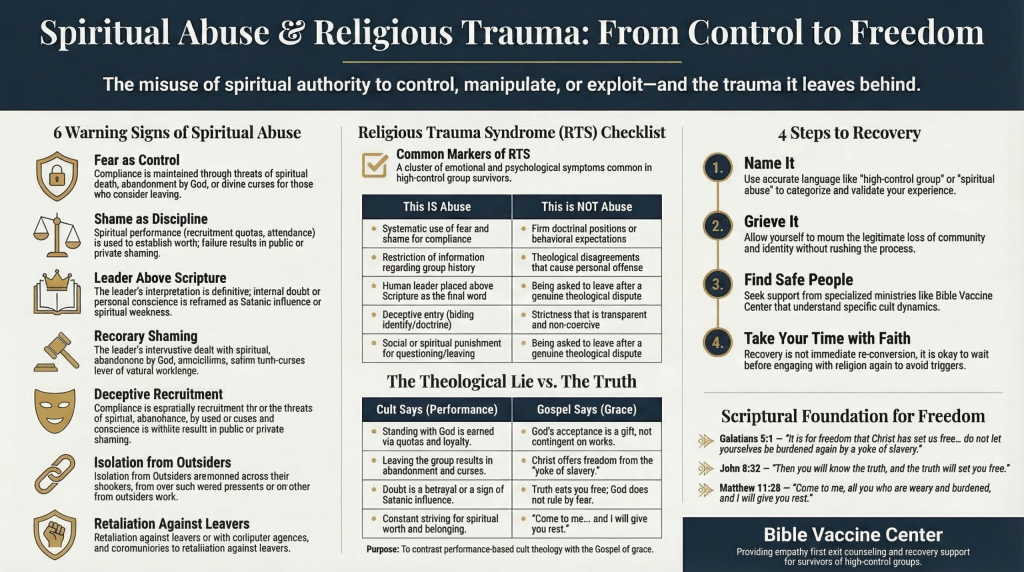
Spiritual abuse is the misuse of spiritual authority, Scripture, or religious community to control, manipulate, or exploit members. It causes genuine psychological and spiritual harm. When that harm is sustained and systemic — as it is in high-control groups — it can produce Religious Trauma Syndrome (RTS): a pattern of fear, identity loss, and spiritual confusion that persists long after a person leaves the group.
Why This Matters
What You Experienced Has a Name
Many survivors of high-control groups do not initially frame what they experienced as abuse. They blame themselves for being deceived. They wonder if their suffering is a divine punishment for leaving. They feel guilty for being angry at an organization they once devoted themselves to completely. Without a clear definition of what spiritual abuse actually is, survivors struggle to locate their experience within a framework that validates it.
This page provides that framework. The goal is not to catalogue every possible form of spiritual harm. It is to define the specific patterns that appear in pseudo-Christian high-control groups, distinguish spiritual abuse from ordinary religious disagreement or strictness, and describe what a path toward healing looks like. If you are reading this because you have left a group and are trying to make sense of what happened, you are in the right place.
On This Page
- What You Experienced Has a Name
- What Is Spiritual Abuse?
- Patterns of Spiritual Abuse in High-Control Groups
- Religious Trauma Syndrome (RTS)
- Spiritual Abuse vs. Ordinary Religious Pain
- Grace vs. Works: The Theological Counter-Framework
- Scriptural Foundation
- Practical Next Steps for Survivors
- Frequently Asked Questions
- Related Articles and Services
Definition
What Is Spiritual Abuse?
Spiritual abuse occurs when a person in a position of religious authority — a leader, a teacher, a community, or a system — uses that authority to manipulate, coerce, or exploit those under their spiritual care. The defining characteristic is that spiritual language, Scripture, or the structure of religious community is weaponized rather than used in service of the person’s genuine flourishing.
The harm is real. Spiritual abuse can produce outcomes that are clinically comparable to other forms of psychological abuse: anxiety, depression, loss of identity, intrusive thoughts, difficulty trusting others, and a distorted relationship with God. It is not a matter of theological disagreement or personal offense at strict expectations. It is a structural pattern of harm.
Spiritual abuse is not limited to high-control groups. It can occur in any religious setting where authority is misused. However, high-control groups are distinguished by the systematic, institutional nature of the abuse — it is not one abusive leader in an otherwise healthy organization. The entire structure, doctrine, and culture of the group produces it.
Free Resource
Get the Full Checklist
Patterns
Patterns of Spiritual Abuse in High-Control Groups
The following patterns are consistent across the East Asian pseudo-Christian high-control groups that Bible Vaccine Center works with: Shincheonji, WMSCOG, Eastern Lightning, Jesus Morning Star, and similar organizations.
Spiritual Authority Placed Above Personal Conscience
Members are taught that the leader’s interpretation of Scripture is the definitive word of God. Any internal resistance — doubt, a sense that something is wrong, the voice of conscience — is reframed as spiritual weakness or Satanic influence. The member’s own moral and spiritual agency is replaced by the group’s hierarchy.
Fear as a Management Tool
High-control groups maintain compliance through sustained fear. Members are told that leaving the group means spiritual death, abandonment by God, divine curse, or exclusion from salvation. This is not a vague theological position — it is actively communicated and reinforced. The fear that “God will punish me for leaving” is one of the most common experiences reported by survivors across all the groups Bible Vaccine Center works with.
Shame as a Disciplinary Mechanism
Spiritual performance is used to establish worth and belonging. Members who fail to meet expectations — in attendance, recruitment quotas, doctrinal knowledge, or behavioral compliance — are shamed individually or publicly. This shame is not incidental. It is the mechanism by which the group maintains behavioral control.
Deceptive Recruitment and Theological Bait-and-Switch
Many survivors describe the experience of being recruited through what appeared to be a genuine, warm Christian community, only to discover months later that the theological content they were being taught was fundamentally different from historic Christianity — and that the identity of the organization had been concealed from them. This deceptive entry is itself a form of harm: the trust placed in a community that appeared spiritually safe is violated in the process.
World Magazine published an article describing this pattern in the context of Shincheonji, which featured Bible Vaccine Center co-founder Chris Iff. The piece is titled “Bait and Switch” — a description that captures the recruitment mechanism accurately.
Isolation from Support Networks
Systematic disconnection from family, previous church community, and outside friends serves two functions: it eliminates the sources of outside perspective that might challenge the group’s teachings, and it makes the group itself the person’s only significant community. This isolation is not incidental — it is a structural feature of high-control group dynamics, and it makes exit profoundly difficult.
Retaliation Against Critics and Former Members
Both Shincheonji and WMSCOG have documented histories of pursuing critics. Shincheonji operates internet teams that pose as ex-members to discredit genuine critics. WMSCOG pursued legal action in the United States against a former member who spoke publicly about her experience — a case in which the court ruled in the former member’s favor and awarded her legal costs. The willingness to punish those who leave and speak is itself evidence of the control dynamic during membership.
Psychology
Religious Trauma Syndrome (RTS)
Religious Trauma Syndrome (RTS) describes a specific cluster of emotional and psychological symptoms that develop from harmful religious experiences — particularly experiences in high-control groups. It is not a formal DSM diagnosis, but the pattern it describes is well-documented in clinical literature and widely recognized by mental health professionals who work with survivors of abusive religious environments.
Common markers of RTS in high-control group survivors include:
- Persistent fear that God is punishing them or has abandoned them for leaving the group
- Confusion about personal identity — “Who am I without this group?”
- Difficulty trusting religious communities, pastors, or spiritual authority of any kind
- Intrusive thoughts related to the group’s teachings (e.g., “What if they were right and I’m cursed?”)
- Grief for the community, relationships, and sense of purpose that were lost when they left
- Anger at having been deceived, sometimes directed at God or all religion
- Physical symptoms of anxiety when exposed to religious environments, worship music, or Scripture
RTS is not a sign of weak faith or psychological fragility. It is the predictable result of sustained psychological and spiritual manipulation. The path through it is not to simply “move on” or “have more faith.” Recovery requires addressing both the psychological and the spiritual dimensions of the harm.
Bible Vaccine Center’s counseling approach, informed by biblical counseling training and the methodology of Bible Vaccine Center Korea, engages both dimensions. The goal is to help survivors distinguish between the distorted image of God they encountered in the high-control group and the God of the Gospel — a God of grace, not performance; freedom, not fear.
Clarification
Spiritual Abuse vs. Ordinary Religious Pain
Not every painful religious experience is spiritual abuse, and not every strict or theologically conservative church is a high-control group. This distinction matters because conflating them makes it harder to identify genuine harm — and makes genuine critique of specific dangerous groups harder to land.
A church that holds firm doctrinal positions, maintains behavioral expectations for members, and teaches that some beliefs are wrong is not automatically spiritually abusive. Spiritual disagreement can be genuine and painful without being abuse.
The distinguishing markers of spiritual abuse are:
- Systematic use of fear and shame as the primary tools of compliance, not conviction and invitation
- Restriction of outside information about the group’s history, leadership, or doctrinal claims
- Punishment — social, spiritual, or otherwise — for questioning or leaving
- A human leader placed above Scripture as the definitive interpreter of divine truth
- Deceptive entry — members are not fully informed about the group’s identity or doctrine before they are emotionally invested
A church that teaches things you disagree with, that hurt your feelings in a sermon, or that asked you to leave after a theological dispute is not necessarily spiritually abusive. A group that systematically deceives, isolates, controls, and punishes is.
The Counter-Framework
Grace vs. Works: The Theological Response
At the core of most high-control group theology is a performance-based understanding of salvation and standing before God. Members earn spiritual worth through recruitment quotas, attendance, doctrinal mastery, or loyalty to the leader. They lose it through doubt, disobedience, or departure. This creates a theology of perpetual striving in which God’s acceptance is always contingent and always at risk.
This is precisely what the New Testament describes as the “yoke of slavery” — a burden placed on people that neither the Law nor any human system can actually bear. Paul’s entire argument in Galatians is a sustained refutation of performance-based religion dressed in spiritual language.
The Gospel of grace is not merely a doctrinal correction to cult theology. It is the therapeutic counter to the psychological harm it causes. When a survivor whose standing before God has been tied to performance hears — and over time truly receives — that God’s acceptance is not contingent on anything they do or fail to do, the healing that begins is not merely emotional. It is the restoration of a person’s fundamental identity.
This is the framework Bible Vaccine Center uses in recovery counseling: identifying the “spiritual lies” the person was taught — God is a taskmaster; leaving means abandonment; doubt is betrayal — and replacing them with the objective truth of the Gospel. Not through argument, but through patient, sustained discipleship and community.
Theological Foundation
Scriptural Foundation
The testimony of Scripture about the character of God runs directly against what high-control groups produce. God does not rule by fear of punishment for honest doubt. Christ does not demand performance as the condition of belonging. The Holy Spirit does not operate through manipulation and information restriction.
For survivors who have been taught that their standing before God is tied to loyalty to a specific group or leader, these passages are not merely comforting. They are theologically corrective. They dismantle the lie at the structural level.
Bible Vaccine Center’s counseling draws on Pastor Yang’s foundational research from Bible Vaccine Center Korea, alongside John Pyon’s training in biblical counseling and Christian apologetics. Recovery work includes targeted Bible study specifically designed to help survivors replace cult theology point by point with the actual teaching of Scripture.
Take Action
Practical Next Steps for Survivors
If you are processing what happened to you, the following steps are practical starting points. They are not a linear program — use them in whatever order makes sense for your situation.
Name what happened
- Giving the experience accurate language is genuinely important. "I was in a high-control group." "I experienced spiritual abuse." "What happened to me has a name." This is the basic cognitive step of accurately categorizing your experience -- which is necessary before healing can begin.
Allow the grief
- Leaving a high-control group involves real loss -- of community, of relationships, of a sense of purpose and identity. The grief for that is legitimate even when the group itself was harmful. Do not rush past it. You can grieve what was lost and still acknowledge what was wrong.
Find people who understand
- General pastoral care from a church with no experience of high-control groups is often unhelpful for survivors. Bible Vaccine Center exists specifically to provide support from people who understand the specific dynamics of high-control group involvement. Chris V describes being alone after leaving Shincheonji -- seeking help from churches in Seattle and being turned away every time. That experience is what built this ministry.
Take your time with faith
- Bible Vaccine Center's priority is exit counseling and support -- not immediate re-conversion. Some survivors need significant time before they can engage with Christianity again without experiencing RTS symptoms. This is understandable. Bible Vaccine Center will not push. The approach is what Chris Iff describes as "pre-evangelism" -- showing love and respect and being a source of truth, without coercion.
COMMON QUESTIONS
Frequently Asked Questions
I left the group but I still feel like God is angry at me. Is that normal?
Is Religious Trauma Syndrome a real clinical condition?
Do I have to become a Christian again to receive help from Bible Vaccine Center?
Can ordinary churches help survivors of high-control groups?
How is Bible Vaccine Center's approach different from secular cult recovery?
Self-assessment
Not sure if it's a cult?
Answer a few honest questions about what you’re seeing. No signup required. Takes 2 minutes.
Share this article:
Home » Spiritual Abuse and Religious Trauma
Related Articles
What Is a Cult?
Helping a Loved One
Post-Cult Counseling
Get Help Evaluating a Specific Group or Church
Bible Vaccine Center specializes in East Asian high-control groups operating in the United States, including Shincheonji, and WMSCOG If you are trying to evaluate a specific group and want an expert perspective, reach out.