
How Shincheonji Recruits and Indoctrinates Your Loved One

Fact Checked by Bible Vaccine Center Editorial Team and

How Shincheonji recruits, builds trust, creates fear of outside criticism, and gradually introduces its beliefs.

What happened to them?

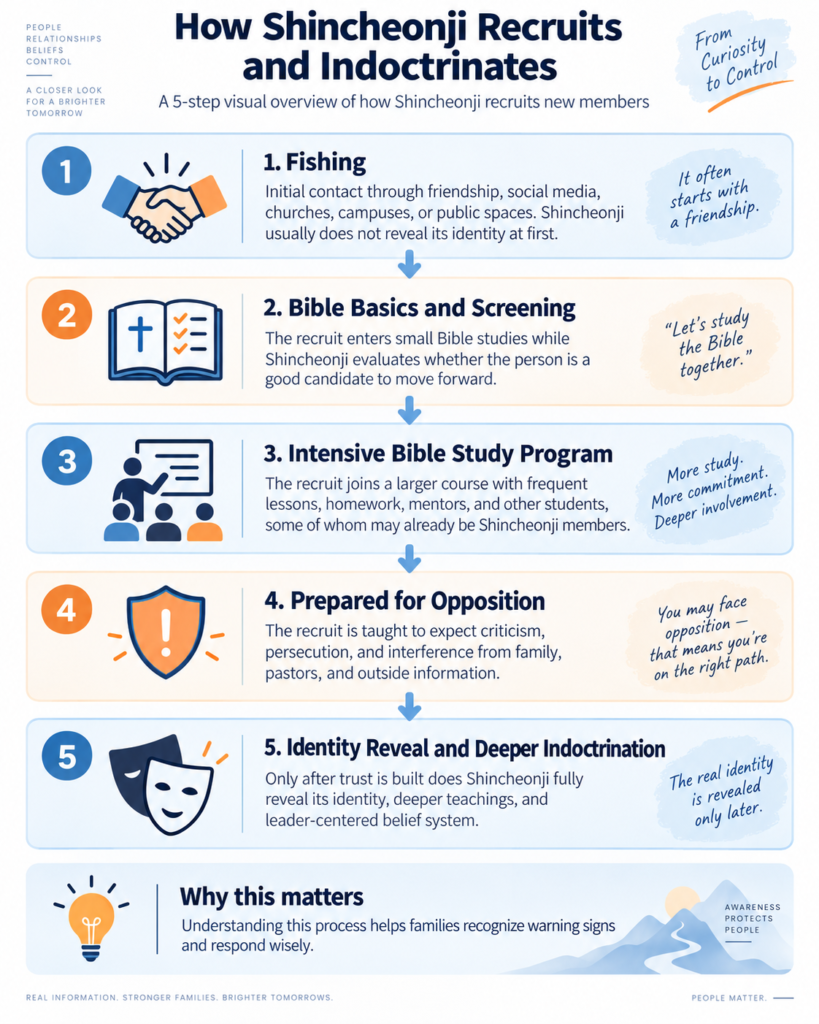
Infographic showing the five-step Shincheonji recruitment and indoctrination process: fishing, Bible Basics and screening, intensive Bible study, preparation for opposition, and the Shincheonji identity reveal.

If someone you love has become involved with Shincheonji, one of the first questions you may be asking is:

“What happened to them?”

They may suddenly be spending far more time in Bible study, becoming secretive about what they are learning, distancing themselves from their church, reacting defensively when Shincheonji is criticized, or beginning to distrust people who are trying to warn them.

To understand these changes, it helps to understand how Shincheonji recruits and gradually introduces its beliefs.

The process usually does not begin with someone openly saying, “I am a member of Shincheonji, and I want you to join.”

Instead, recruitment often begins through friendship, Bible study, Christian fellowship, social media, university campuses, churches, or public spaces. The person may spend weeks or months involved before they learn who is actually behind the Bible study.

How Shincheonji First Approaches Potential Recruits

Step 1: The “Fishing” Process

The first step is commonly referred to as “fishing.”

This is when Shincheonji members identify and approach potential recruits.

The initial contact can happen in many different ways. It may be online through Instagram or other social media, through Christian communities, at a shopping mall, on a university campus, at a Christian event, or even inside an existing church.

The important thing to understand is that the person being approached is generally not told that the recruiter is a Shincheonji member.

Instead, the interaction usually appears natural and harmless.

Social Media Recruiting

One former participant described being contacted through Instagram after posting Christian content.

The recruiter began a friendly conversation about Christianity, which eventually led to an invitation to Bible study.

Ever since COVID, SCJ started recruiting heavily through Instagram

Another former recruit described being contacted by a stranger through Instagram and eventually joining a Bible study without initially knowing that the group was connected to Shincheonji.

Investigative reporting has also documented Shincheonji recruitment training that instructed members on how to search university-related Instagram pages, find student organizations, browse followers, identify potential recruits, and begin conversations with them.

Church Infiltration

Shincheonji members have also entered existing Christian churches in order to develop relationships with Christians and eventually invite them to outside Bible studies.

The Shincheonji member may initially appear to simply be another Christian looking for fellowship.

They may attend services, participate in church activities, build friendships, exchange phone numbers, and establish trust before introducing an outside Bible study.

One pastor publicly documented his experience after discovering that Shincheonji members had entered his church and begun developing relationships with people within the congregation:

https://youtu.be/IKHPllt5Rp0

This type of recruitment can be especially effective because the relationship begins inside an environment where the person already expects to be surrounded by other Christians.

University Recruitment

University campuses are another common environment for Shincheonji recruitment.

Students may be approached through surveys, casual conversations, university clubs, Christian organizations, or questions about religion and spirituality.

For example, one university student described being approached and asked to participate in a survey. The conversation eventually turned toward Christianity, and the student was introduced to a group that claimed to help Christians better understand the Bible.

The interaction eventually led to a Bible study connected to Shincheonji:

https://www.reddit.com/r/Shincheonji/comments/1q1jd4b/recently_learned_of_scj_activity_on_my_campus/

University recruitment has also been documented by investigative journalists, including organized efforts to identify and approach university students both online and in person.

Shopping Malls and Public Places

Another common method is approaching people in shopping malls or other public locations.

Sometimes the conversation begins with a survey. Other times, recruiters may ask questions about Christianity, compliment someone, ask for help with a project, or simply attempt to start a friendship.

The conversation may seem completely unrelated to Shincheonji at first.

However, after contact information is exchanged, the relationship can gradually move toward conversations about Christianity and eventually an invitation to Bible study.

Although the exact method varies, the general goal of the fishing stage is the same:

Find someone who may be receptive, establish trust, and create a pathway toward a Bible study without initially revealing Shincheonji’s involvement.

The Worthiness Criteria of Shincheonji

Step 2: How Shincheonji Screens and Evaluates New Recruits

Once a potential recruit has been contacted and appears interested, they may then be introduced to smaller Bible studies sometimes referred to as “Bible Basics.”

During this process, there are two important things happening.

The first is that Shincheonji is determining whether the recruit is considered “worthy” or suitable to continue further into the recruitment process.

The early Bible study is therefore not only about teaching the recruit. It is also an opportunity for Shincheonji members to determine whether they believe the person is worth investing additional time and resources into recruiting.

The criteria can vary depending on the branch or recruiting environment, but examples can include:

Worthiness Checklist

This also helps explain why recruiters may ask seemingly unrelated or personal questions during the early stages.

They may want to learn about the person’s age, occupation, financial situation, church involvement, relationships, family, schedule, and other aspects of their life.

They may also be considering questions such as:

Reporting Metrics per Recruit

From the recruit’s perspective, these questions may simply seem like part of getting to know one another.

The recruiter, however, may know far more about the actual purpose of the relationship than the recruit does.

The second thing happening during Bible Basics is the gradual establishment of trust and authority.

The recruit begins developing trust in the person teaching them while also becoming accustomed to Shincheonji’s way of interpreting Scripture.

At this stage, the individual may still have no idea that they are studying with Shincheonji. From their perspective, they may simply believe that they have met sincere Christians who want to help them understand the Bible.

The Shincheonji Bible Study (Overview)

Step 3: Inside Shincheonji’s Intensive Bible Study Program

If the recruit passes the initial evaluation and continues showing interest, they may then be invited into the larger Shincheonji Bible-study program.

This is where the process becomes much more intensive.

The recruit may begin attending lessons several times per week, completing homework, taking tests, meeting with instructors or mentors, and spending increasing amounts of time with people connected to the Bible study.

At this stage, the recruit may also be surrounded by other “students” who appear to be learning the material alongside them.

What the recruit may not realize is that some of these students can already be Shincheonji members.

These members are sometimes referred to as “leaves.”

Their role can include encouraging the recruit, modeling enthusiasm for the lessons, answering questions in ways that reinforce the teacher’s explanations, and reporting concerns back to the recruiters.

From the recruit’s perspective, however, these individuals may simply appear to be fellow students discovering the teachings for the first time.

This can create the impression that multiple independent people are reaching the same conclusions about the Bible, when some of those people are already committed members of Shincheonji.

As the course continues, the time commitment generally increases, the doctrines become more specific, and the recruit becomes increasingly immersed in Shincheonji’s interpretation of Scripture.

Definitions

Leaves

A current Shincheonji member pretending to be a new student in their Bible Studies, known as “center”.

The leaf will spy and report on the new students (fruits), and thus create a “mystical experience“

Fruit

A new student of a Shincheonji Bible Study. Often, the fruits are unaware of being spied on, and are often unaware of the Bible Study being affilitated with Shincheonji.

Preparing the Recruit for Opposition

Step 4: How Shincheonji Prepares Recruits to Reject Criticism

While Shincheonji is teaching its interpretation of the Bible, something else is also happening. The student is gradually being taught how to interpret future criticism of the Bible study.

This is extremely important for understanding why a family member can discover Shincheonji, present accurate information to their loved one, and still find that the person refuses to listen. By the time that confrontation occurs, the student may have already spent months being prepared for it.

The Four Fields: “Don’t Let Satan Steal Your Seed”

One of the earliest lessons in Shincheonji’s Bible study concerns the parable of the sower and the four soils. Jesus explains:

The seed is the word of God.

Luke 8:11

He then explains what happens to the seed that falls along the path:

Then the devil comes and takes away the word from their hearts…

Luke 8:12

Within Shincheonji’s Bible study, the student is taught that they must protect the seed they are receiving. This can create an important association very early in the course:

If someone tries to persuade me to stop studying, Satan may be attempting to take the seed away from me.

That association becomes important later. A parent may believe they are warning their child about a deceptive organization. The student may instead perceive the parent’s warning as fulfillment of something their Bible teacher already told them would happen.

Protecting the “Hidden Treasure”

Another early lesson involves Jesus’ parable of the treasure hidden in the field:

The kingdom of heaven is like treasure hidden in a field. When a man found it, he hid it again…

Matthew 13:44

Within the Bible study, this can reinforce the idea that something spiritually valuable does not necessarily need to be immediately shared with everyone. Secrecy can therefore begin to feel less suspicious.

Rather than asking:

“Why am I being told not to tell my family everything about this Bible study?”

the student may begin thinking:

“There are some things I need to protect until the proper time.”

Why Persecution Becomes Expected

Another recurring theme throughout the Bible study is persecution. Students are exposed to biblical stories in which God’s people are rejected or opposed by religious authorities. One example is the man born blind in John 9.

After Jesus heals him, the Pharisees question both the man and his parents. His parents are afraid of the religious authorities:

His parents said this because they were afraid of the Jewish leaders…

John 9:22

The healed man is eventually thrown out after continuing to defend what happened to him. Stories like this can be used to reinforce the broader message that people who possess God’s truth have historically faced opposition and persecution.

That can cause criticism to function in an unexpected way. Instead of causing the student to question the Bible study, opposition can actually strengthen their confidence in it.

  • If their pastor objects, that can be interpreted as persecution.
  • If their parents become concerned, that can be interpreted as persecution.
  • If a friend sends them information criticizing Shincheonji, that can be interpreted as an attempt to steal the seed.

“Satan May Work Through the People Closest to You”

Shincheonji does not necessarily tell members that their parents literally are Satan. Instead, members can be taught that Satan may work through the people closest to them, including parents, friends, and pastors, to interfere with the “truth.” This means normal concern from family can be reinterpreted as spiritual persecution rather than as a reason to reconsider the group.

There are several documented examples of this.

Reporting from Australia

ABC Australia reported in 2025 that one former member was taught from the beginning that if the Bible study contained God’s Word, Satan would try to interrupt her from receiving it. She was also told not to discuss Shincheonji with friends or family so that Satan would not interfere with her judgment.

ABC additionally obtained a Shincheonji lesson instructing members to disable location sharing on their phones to prevent persecution. The lesson explained that this was done to protect parents so they would not be used by Satan to persecute the member.

A University of Melbourne student publication interviewed a Christian youth pastor who had encountered Shincheonji recruitment among students. He described recruits being warned that once they begin discovering the truth, Satan will try to deceive them. According to him, if a friend tells them to stop attending, or if their parents tell them the Bible study is not good, this can be interpreted as Satan deceiving them.

Accounts from South Korea

Former members in South Korea have described a similar dynamic. In an interview with the Korea JoongAng Daily, former member Kim En-na explained that members were taught to divide the world into what was for God and what was against God. Because supporting Shincheonji was equated with supporting God, opposition to Shincheonji could be interpreted as being aligned with the devil.

Accounts from Former Members Online

Former members of r/Shincheonji have also described how these teachings affected them in practice. One former member wrote that when family members questioned why they were attending Bible study seven days a week, they became defensive because they interpreted the concern as persecution and the work of the devil.

Taken together, these examples help explain why a well-intentioned family confrontation can sometimes backfire.

The parent may be thinking:

“I am trying to protect you.”

But the Shincheonji student may have already been taught to interpret that same intervention as:

“Satan is using someone close to me to take me away from the truth.”

This does not mean the family should stay silent. It means that the manner in which the family approaches the person matters, because an aggressive confrontation can unintentionally reinforce the exact persecution narrative the student has already been prepared to expect.

Why This Matters for Families Helping Someone Leave Shincheonji

This creates what can be described as a self-sealing belief system. The student is not simply learning what to believe. They are also learning how to interpret information that challenges those beliefs.

By the time they discover that Shincheonji is behind the Bible study, they may already have a framework that tells them:

  • Satan will try to steal the Word.
  • Family members may unknowingly be used to interfere.
  • Pastors may persecute people who possess the truth.
  • Outside information may contain lies.
  • Opposition is something God’s people should expect.
  • Leaving the Bible study could mean losing the truth they have received.

This is one of the most important things to understand before trying to help someone leave Shincheonji. If you immediately attack Shincheonji, call the group a cult, ridicule Lee Man-hee, or demand that the person leave, you may unintentionally behave exactly as they have been told an opponent of the truth would behave.

That does not mean that you should avoid discussing the problems with Shincheonji. It means that how you introduce those problems matters. Someone who has spent months being taught how to defend themselves against outside criticism should not necessarily be approached the same way as someone who has attended only a handful of lessons.

That is why helping someone leave Shincheonji requires more than simply giving them information. You first have to understand how Shincheonji has taught them to process that information.

The Big Reveal

Step 5: When Shincheonji Reveals Its Identity and Deepens Indoctrination

As the Bible course progresses, Shincheonji’s teachings become increasingly specific.

The student moves beyond introductory Bible lessons and begins learning Shincheonji’s framework for parables, prophecy, fulfillment, Revelation, and the idea that biblical prophecy must be physically fulfilled.

Eventually, the identity of Shincheonji and its leader, Lee Man-hee, is revealed.

By this point, however, the student may have already spent months:

  • Building close relationships with recruiters and other students
  • Adopting Shincheonji’s framework for interpreting Scripture
  • Increasing their weekly time commitment
  • Learning to distrust criticism and outside information
  • Expecting persecution from people who disagree
  • Believing that they have discovered biblical truths that ordinary churches do not understand

This is why the reveal does not necessarily cause the person to immediately walk away.

By the time the name Shincheonji is introduced, the organization may no longer feel like a strange group they discovered online.

Instead, it may feel like the natural conclusion of months of Bible study.

The person’s trust was not built around the name “Shincheonji.”

It was built around the teachers, friendships, Bible lessons, and interpretive system they had already come to trust.

This is also why telling someone, “Just Google Shincheonji,” may not work once they are several months into the process.

They may already have been taught how to interpret what they are going to find.

Understanding this progression helps answer the question:

“What happened to my loved one?”

They did not simply wake up one day and decide to distrust their family or devote their life to an unfamiliar religious group.

They were gradually introduced to a new social environment, new relationships, a new way of interpreting the Bible, and eventually a new way of interpreting the people who disagreed with them.

In the follow-up article, we will look at how to help a loved one leave Shincheonji, including how your approach should change depending on how deeply involved they are.

Common questions

Frequently Asked Questions About Shincheonji Recruitment and Indoctrination

How does Shincheonji recruit new members?

Shincheonji typically recruits new members through a gradual process that can involve several months of Bible study, often around 6 to 12 months. Recruits may initially be unaware that the Bible study is connected to Shincheonji. Over time, the course becomes more intensive, introduces Shincheonji’s interpretations of Scripture, and gradually prepares the student for the eventual reveal of the group’s identity.

Yes. Shincheonji often conceals its identity during the early stages of recruitment, sometimes using Bible studies, ministries, peace organizations, or Christian-sounding front groups that do not clearly disclose their connection to Shincheonji. Reported names on r/Shincheonji include New Heaven New Earth (NHNE), Zion Christian Mission Center (ZCMC), HWPL, IPYG, IWPG, WARP, We Are One, Bible Study For All, Christians of NorCal, Ignite Ministries, True Vine SF, Open Bible Academy, International Bible College, Zion Bible Study, Pathways, Rakau o te Ora, Life Group Bible Study, Seasons, Zest, and Word of Life Theology. The names can vary by location and may change over time.

Possible warning signs include becoming unusually secretive about a Bible study, spending significantly more time attending lessons, or becoming defensive when the group is questioned. Shincheonji Bible studies also commonly emphasize topics such as the “secrets of the kingdom of heaven,” the parables of Jesus, prophecy and fulfillment, and the book of Revelation. A person may also avoid identifying the name of the church or ministry behind the study, especially during the earlier stages of recruitment.

Shincheonji can use what is sometimes called phobia indoctrination, where recruits are taught to fear outside interference with the Bible study. They may be told that Satan can work through family members, friends, pastors, or outside information to pull them away from the “truth.” As a result, secrecy can begin to feel spiritually necessary rather than suspicious, especially if the recruit believes they are protecting the “seed” or the “secrets of the kingdom of heaven.”

Shincheonji uses current members, sometimes called “leaves,” to pose as fellow Bible-study students. These members can observe new recruits, report information back to leaders, and help reinforce the lessons being taught. They may also help manage the group dynamic if a recruit begins questioning the Bible study or discovers its connection to Shincheonji, including limiting how much those concerns spread to other new students.

Shincheonji teaches that believers are engaged in a “war of doctrines” between God’s truth and false teaching. Members may also be taught that “eating from the fruit of the tree of the knowledge of good and evil” can represent receiving mixed or false teachings that contradict Shincheonji’s interpretation of the Bible. As a result, criticism from family, pastors, former members, or outside sources may be viewed not simply as disagreement, but as a spiritual attack or an attempt to pull them away from the truth. This can reinforce the belief that opposition is evidence that they are being persecuted.

Yes. Shincheonji teaches that Satan can work through other people, including family members, friends, and pastors, to interfere with someone receiving or remaining in the “truth.” If a family member tries to persuade the person to stop attending the Bible study or leave Shincheonji, that concern may be interpreted as Satan working through that person to pull them away from God’s Word.

Yes. Shincheonji teaches that Satan can work through other people, including family members, friends, and pastors, to interfere with someone receiving or remaining in the “truth.” If a family member tries to persuade the person to stop attending the Bible study or leave Shincheonji, that concern may be interpreted as Satan working through that person to pull them away from God’s Word.

Generally, an aggressive confrontation is not recommended. Calling Shincheonji a cult, attacking its leader, or demanding that your loved one leave can reinforce the persecution narrative they may already have been taught to expect. Instead, focus first on maintaining and strengthening your relationship with them. Listen, remain curious, and gradually ask thoughtful questions about their beliefs rather than immediately trying to prove them wrong.

For more practical guidance, see our upcoming article on how to help a loved one in Shincheonji.

You should warn them about Shincheonji, but the way you do it matters. Avoid an aggressive confrontation, ridicule, or demanding that they immediately leave. Instead, clearly express your concerns, explain what you have learned about Shincheonji’s recruitment practices, and ask questions that encourage them to examine the group for themselves. Because members may already be taught to interpret criticism as persecution, a calm and relational approach is usually more effective than attacking the group directly.

Have a Loved One in Shincheonji?

Talk with Someone Who Understands Cults

Knowing how Shincheonji recruits is only the first step. Learn how to talk with your loved one, avoid reinforcing the group’s persecution narrative, ask better questions, and help them begin thinking critically about what they have been taught.

Share this article:
Facebook
LinkedIn
Reddit
X

Related Articles

What Is a Cult?

The foundational definition of a high-control group, including the specific groups Bible Vaccine Center focuses on and the theological markers of a pseudo-Christian cult.

Spiritual Abuse

How to recognize spiritual abuse and what recovery looks like for survivors of high-control religious environments.

Helping a Loved One

Practical guidance for families. Why confrontation backfires and what actually helps.

Get Help Evaluating a Specific Group or Church

Bible Vaccine Center specializes in East Asian high-control groups operating in the United States, including Shincheonji, WMSCOG, Eastern Lightning, Jesus Morning Star, and Iglesia ni Cristo. If you are trying to evaluate a specific group and want an expert perspective, reach out.