

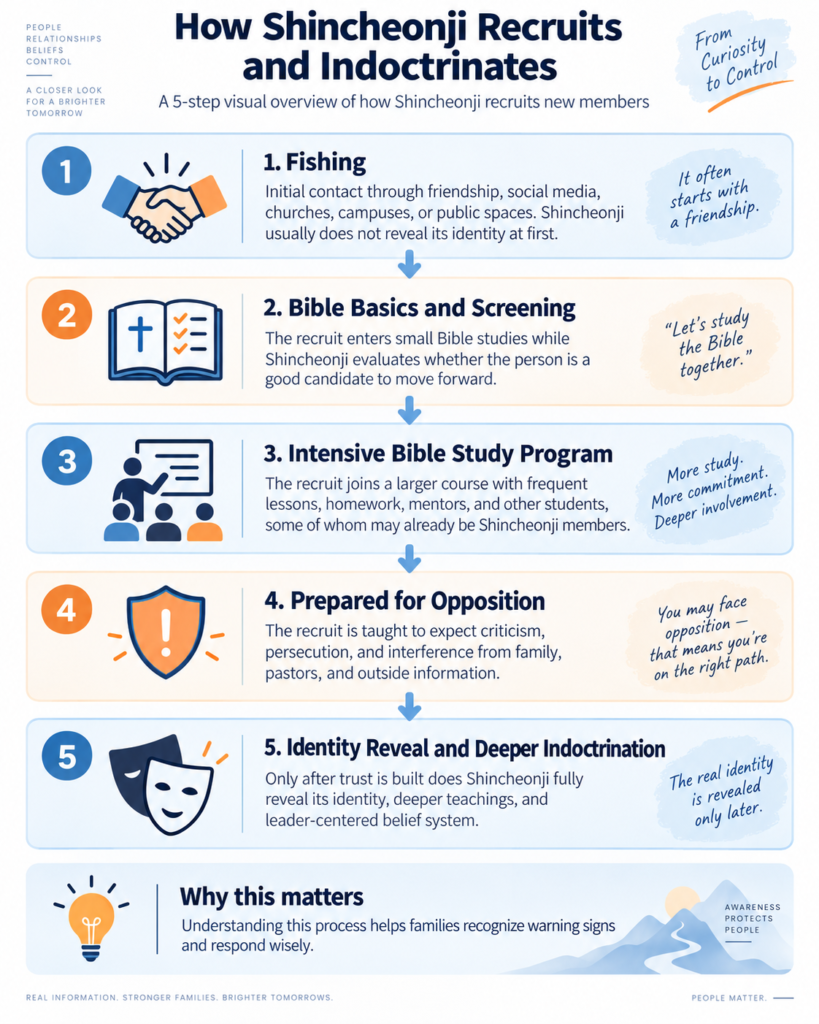
While Shincheonji is teaching its interpretation of the Bible, something else is also happening. The student is gradually being taught how to interpret future criticism of the Bible study.
This is extremely important for understanding why a family member can discover Shincheonji, present accurate information to their loved one, and still find that the person refuses to listen. By the time that confrontation occurs, the student may have already spent months being prepared for it.
The Four Fields: “Don’t Let Satan Steal Your Seed”
One of the earliest lessons in Shincheonji’s Bible study concerns the parable of the sower and the four soils. Jesus explains:
The seed is the word of God.
Luke 8:11
He then explains what happens to the seed that falls along the path:
Then the devil comes and takes away the word from their hearts…
Luke 8:12
Within Shincheonji’s Bible study, the student is taught that they must protect the seed they are receiving. This can create an important association very early in the course:
If someone tries to persuade me to stop studying, Satan may be attempting to take the seed away from me.
That association becomes important later. A parent may believe they are warning their child about a deceptive organization. The student may instead perceive the parent’s warning as fulfillment of something their Bible teacher already told them would happen.
Protecting the “Hidden Treasure”
Another early lesson involves Jesus’ parable of the treasure hidden in the field:
The kingdom of heaven is like treasure hidden in a field. When a man found it, he hid it again…
Matthew 13:44
Within the Bible study, this can reinforce the idea that something spiritually valuable does not necessarily need to be immediately shared with everyone. Secrecy can therefore begin to feel less suspicious.
Rather than asking:
“Why am I being told not to tell my family everything about this Bible study?”
the student may begin thinking:
“There are some things I need to protect until the proper time.”
Why Persecution Becomes Expected
Another recurring theme throughout the Bible study is persecution. Students are exposed to biblical stories in which God’s people are rejected or opposed by religious authorities. One example is the man born blind in John 9.
After Jesus heals him, the Pharisees question both the man and his parents. His parents are afraid of the religious authorities:
His parents said this because they were afraid of the Jewish leaders…
John 9:22
The healed man is eventually thrown out after continuing to defend what happened to him. Stories like this can be used to reinforce the broader message that people who possess God’s truth have historically faced opposition and persecution.
That can cause criticism to function in an unexpected way. Instead of causing the student to question the Bible study, opposition can actually strengthen their confidence in it.
- If their pastor objects, that can be interpreted as persecution.
- If their parents become concerned, that can be interpreted as persecution.
- If a friend sends them information criticizing Shincheonji, that can be interpreted as an attempt to steal the seed.
“Satan May Work Through the People Closest to You”
Shincheonji does not necessarily tell members that their parents literally are Satan. Instead, members can be taught that Satan may work through the people closest to them, including parents, friends, and pastors, to interfere with the “truth.” This means normal concern from family can be reinterpreted as spiritual persecution rather than as a reason to reconsider the group.
There are several documented examples of this.
Reporting from Australia
ABC Australia reported in 2025 that one former member was taught from the beginning that if the Bible study contained God’s Word, Satan would try to interrupt her from receiving it. She was also told not to discuss Shincheonji with friends or family so that Satan would not interfere with her judgment.
ABC additionally obtained a Shincheonji lesson instructing members to disable location sharing on their phones to prevent persecution. The lesson explained that this was done to protect parents so they would not be used by Satan to persecute the member.
A University of Melbourne student publication interviewed a Christian youth pastor who had encountered Shincheonji recruitment among students. He described recruits being warned that once they begin discovering the truth, Satan will try to deceive them. According to him, if a friend tells them to stop attending, or if their parents tell them the Bible study is not good, this can be interpreted as Satan deceiving them.
Accounts from South Korea
Former members in South Korea have described a similar dynamic. In an interview with the Korea JoongAng Daily, former member Kim En-na explained that members were taught to divide the world into what was for God and what was against God. Because supporting Shincheonji was equated with supporting God, opposition to Shincheonji could be interpreted as being aligned with the devil.
Accounts from Former Members Online
Former members of r/Shincheonji have also described how these teachings affected them in practice. One former member wrote that when family members questioned why they were attending Bible study seven days a week, they became defensive because they interpreted the concern as persecution and the work of the devil.
Taken together, these examples help explain why a well-intentioned family confrontation can sometimes backfire.
The parent may be thinking:
“I am trying to protect you.”
But the Shincheonji student may have already been taught to interpret that same intervention as:
“Satan is using someone close to me to take me away from the truth.”
This does not mean the family should stay silent. It means that the manner in which the family approaches the person matters, because an aggressive confrontation can unintentionally reinforce the exact persecution narrative the student has already been prepared to expect.
Why This Matters for Families Helping Someone Leave Shincheonji
This creates what can be described as a self-sealing belief system. The student is not simply learning what to believe. They are also learning how to interpret information that challenges those beliefs.
By the time they discover that Shincheonji is behind the Bible study, they may already have a framework that tells them:
- Satan will try to steal the Word.
- Family members may unknowingly be used to interfere.
- Pastors may persecute people who possess the truth.
- Outside information may contain lies.
- Opposition is something God’s people should expect.
- Leaving the Bible study could mean losing the truth they have received.
This is one of the most important things to understand before trying to help someone leave Shincheonji. If you immediately attack Shincheonji, call the group a cult, ridicule Lee Man-hee, or demand that the person leave, you may unintentionally behave exactly as they have been told an opponent of the truth would behave.
That does not mean that you should avoid discussing the problems with Shincheonji. It means that how you introduce those problems matters. Someone who has spent months being taught how to defend themselves against outside criticism should not necessarily be approached the same way as someone who has attended only a handful of lessons.
That is why helping someone leave Shincheonji requires more than simply giving them information. You first have to understand how Shincheonji has taught them to process that information.