
What Is a Cult?
Fact Checked by Bible Vaccine Center Editorial Team and
-
Written by Chris Vishoot
- Last Updated
Why This Matters
Why Understanding What a Cult Is Can Protect You and Your Family
The word “cult” carries a stigma that works against clear thinking. People picture extreme fringe groups, mass suicides, or isolated compounds. That picture misses how high-control groups actually operate today. They are active on college campuses. They run legitimate-looking Bible study groups. They recruit inside churches. They use social media. And they target people who are sincere, curious, and genuinely searching for God. Cult brainwashing and coercive control do not require a compound or a charismatic madman. They happen in ordinary settings, to ordinary people, one careful relationship at a time.
Understanding what a cult is, with precision rather than just emotion, is the first step toward protection. For families watching a loved one change, for church leaders who want to guard their congregation, and for survivors trying to make sense of what happened to them, a clear definition gives language to an experience that often feels impossible to describe.
On This Page
- Why Understanding What a Cult Is Can Protect You
- What Is the Difference Between a Cult and a Religion?
- Four Characteristics of a Cult: The BITE Model Explained
- Warning Signs of Cult Brainwashing and Mind Control
- How Do I Know If I Am in a Cult?
- What Is a Pseudo-Christian Cult?
- Cult Examples: High-Control Groups Active in the United States
- Who Joins a Cult and Why?
- Biblical Framework for Identifying False Teaching
- What to Do If Someone You Love Is in a Cult
- Frequently Asked Questions About Cults
- Related Articles and Services
Terminology
What Is the Difference Between a Cult and a Religion?
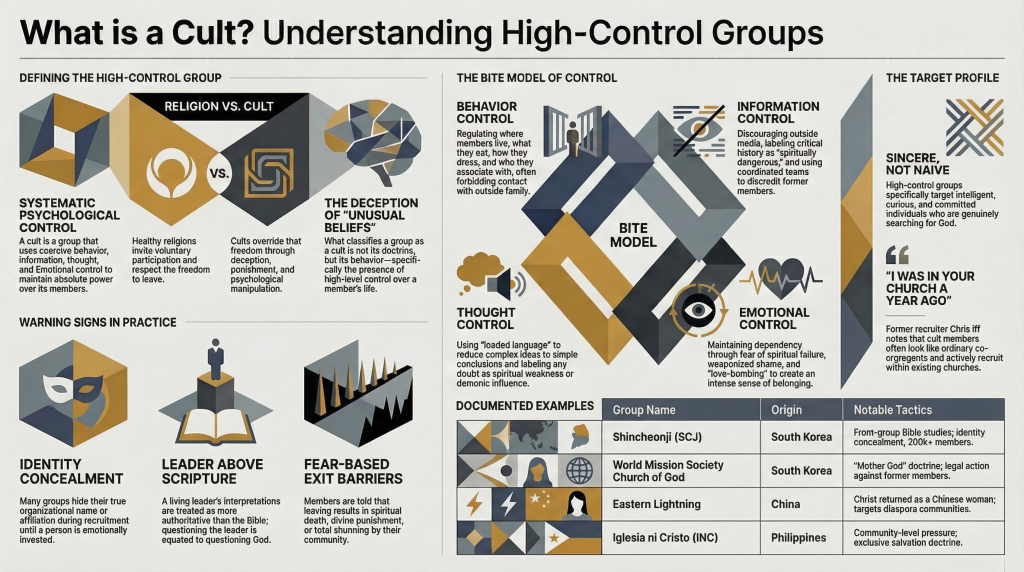
The difference between a cult and a religion is not about unusual beliefs. Many religious communities hold minority doctrinal positions without being controlling or harmful. A religion, in its healthy form, invites voluntary participation, permits honest questioning, and respects each person’s freedom to stay or leave. A cult overrides that freedom through systematic psychological control.
The term “high-control group” is the more precise academic designation. It describes what the organization actually does: it exercises high levels of control over its members’ behavior, access to information, thoughts, and emotional lives. The word “cult” is the common term most people recognize, and it remains widely used for that reason.
Bible Vaccine Center uses both terms. In formal educational contexts, “high-control group” is preferred because it focuses on the mechanics of control rather than the emotional charge of the word “cult.” In everyday conversation and search, “cult” is the word people use when they are in crisis and searching for help. Both terms point to the same reality.
The line is crossed when a group uses deception in recruitment, restricts access to outside information, demands unquestioning obedience to a human leader above Scripture, and punishes members who attempt to question or leave. That is what classifies a group as a cult, regardless of its stated religious affiliation.
The Framework
Four Characteristics of a Cult: The BITE Model Explained
What are the four characteristics of a cult? The most widely used academic framework for answering that question is the BITE Model, developed by Dr. Steven Hassan, a former member of the Unification Church who went on to become one of the leading authorities on cult influence, coercive control, and undue influence. Chris Iff, co-founder of Bible Vaccine Center, is currently being mentored and trained by Dr. Hassan.
BITE stands for four dimensions of control: Behavior, Information, Thought, and Emotional. Together, these four characteristics define what classifies a group as a cult and separate a high-control group from a demanding but healthy religious community:
Behavior Control
The group regulates where members live, what they eat, how they dress, who they associate with, and how they spend their time. Members may be required to spend large amounts of time in group activities. Contact with family and friends outside the group is discouraged or forbidden.
Information Control
Members are discouraged from reading, watching, or listening to anything produced outside the group. Critical information about the group's history is labeled "spiritually dangerous." Former members who speak out are discredited. Shincheonji runs coordinated internet teams that pose as ex-members to seed confusion and discredit genuine critics.
Thought Control
The group teaches members a specialized vocabulary that reframes reality in the group's favor. Loaded language reduces complex ideas to simple, group-approved conclusions. Members are taught to label any doubt as spiritual weakness or Satanic influence. Independent critical thinking is treated as a threat.
Emotional Control
Members are kept in a state of emotional dependency. Fear of spiritual failure, punishment, or being "cut off" from God is used to maintain compliance. Shame is weaponized against those who question. Intense emotional highs created by group activities make the group feel like the only source of meaning and joy.
The BITE Model is not a theological test. It is a behavioral and psychological one. A group does not need to have false doctrine to be controlling. Conversely, a group with genuinely false doctrine may not exercise BITE-level control. Both problems matter, but they are distinct. Any organization that exercises significant control across most or all of these four characteristics qualifies as a cult, regardless of its stated religious affiliation.
Free Resource
Get the Full Checklist
Red Flags
Common Warning Signs of a High-Control Group
Knowing the four characteristics of a cult through the BITE Model is the foundation. The following warning signs show how cult brainwashing and mind control appear in practice, based on patterns that Bible Vaccine Center and allied organizations have documented across high-control groups:
- Identity concealment during recruitment. The group hides its true identity or affiliation until a recruit is already emotionally invested. Shincheonji and WMSCOG are both known for running front-group Bible studies that do not reveal their organizational identity until weeks or months in.
- Deception justified as a spiritual tool. Some groups teach that lying to outsiders is acceptable because the spiritual goal justifies the method. Shincheonji’s theology explicitly permits this.
- Fear-based exit barriers. Members are told that leaving the group means spiritual death, divine punishment, or permanent separation from God.
- Shunning and social isolation. Former members who speak out are cut off entirely. Remaining members are instructed not to have contact with them.
- Totalistic worldview. The group alone has the truth. All outside religious institutions are spiritually corrupt or controlled by Satan.
- Rapid, intense recruitment process. Potential members are love-bombed: showered with attention, affirmation, and a sense of belonging before the demands of membership become clear. This tactic is a hallmark of manipulative cult recruitment.
What Is a Pseudo-Christian Cult?
A pseudo-Christian cult is an organization that uses the language and symbols of Christianity — Jesus, the Bible, salvation, the church — while teaching doctrines that contradict historic Christian orthodoxy at foundational points.
The primary doctrinal markers that identify a group as pseudo-Christian include:
- Identity concealment during recruitment. The group hides its true identity or affiliation until a recruit is already emotionally invested. Shincheonji and WMSCOG are both known for running front-group Bible studies that do not reveal their organizational identity until weeks or months in.
- The Leader cannot be questioned. The leader’s interpretations are treated as more authoritative than the Bible itself. Questioning the leader is equivalent to questioning God.
- Deception justified as a spiritual tool. Some groups teach that lying to outsiders is acceptable because the spiritual goal justifies the method. Examples include Shincheonji’s documented use of the “Wisdom of Hiding”.
- Fear-based exit barriers. Members are told that leaving the group means spiritual death, divine punishment, or permanent separation from God.
- Shunning and social isolation. Former members who speak out are cut off entirely. Remaining members are instructed not to have contact with them.
- Totalistic worldview. The group alone has the truth. All outside religious institutions are spiritually corrupt or controlled by Satan.
- Intense recruitment process. Potential members are love-bombed: showered with attention, affirmation, and a sense of belonging before the demands of membership become clear. This tactic is a hallmark of manipulative cult recruitment.
Self-Assessment
How Do I Know If I Am in a Cult?
If you are reading this page because something about your own group feels wrong, that instinct matters. The fact that you are asking “how do I know if I’m in a cult?” is not a sign of weak faith. It is a sign that your conscience is working the way God designed it to work.
Consider whether your experience includes any of the following patterns. You do not need to check every box. Even two or three should prompt serious reflection:
- You were not told the group’s full identity when you first joined. The Bible study, mentorship, or community that drew you in turned out to be connected to an organization you were not told about upfront.
- You feel afraid to ask hard questions. Doubts are treated as spiritual failures. Leaders respond to honest questions with correction, shame, or concern about your faith rather than with patient, open answers.
- You have been told to limit contact with family or friends outside the group. The reasoning may sound spiritual (“they will weaken your faith”), but the result is isolation from everyone who knew you before.
- Leaving feels impossible or terrifying. You have been told, directly or indirectly, that leaving means spiritual death, divine punishment, or permanent separation from God.
- One leader’s interpretation is treated as equal to or above Scripture. Questioning the leader’s teaching is treated as questioning God himself.
- You have been asked to deceive others on behalf of the group. Lying to outsiders about the group’s identity, activities, or beliefs is justified as serving a higher spiritual purpose.
- Your time, finances, and relationships are controlled. The group determines how you spend your hours, how much money you give, and who you are allowed to associate with.
If several of these resonate with your experience, you are not losing your mind and you are not betraying God. You may be in a high-control group. Bible Vaccine Center exists to help people in exactly this situation. You can reach out confidentially, with no pressure and no judgment.
Doctrine
What Is a Pseudo-Christian Cult?
A pseudo-Christian cult is an organization that uses the language and symbols of Christianity, including Jesus, the Bible, salvation, and the church, while teaching doctrines that fundamentally contradict historic Christian orthodoxy. These groups are among the most common cult examples operating in the United States today.
The primary doctrinal markers that identify a group as pseudo-Christian include:
- Denial of the Trinity. Rejecting that God exists as Father, Son, and Holy Spirit is a departure from the core of Christian theology affirmed by every major historical tradition since the early church councils.
- Denial of the full deity of Christ. Teaching that Jesus is a created being, a prophet only, or a spiritual force rather than God incarnate places the group outside the bounds of historical Christian faith.
- A leader as the final authority. When a contemporary figure’s teachings supersede or reinterpret Scripture, biblical authority has been replaced.
- Salvation through works or group membership. Replacing salvation by grace through faith alone with ritual performance, group membership, or doctrinal compliance is a departure from the Gospel as defined in the New Testament.
Bible Vaccine Center’s approach is not to dismiss these groups as unworthy of serious theological engagement. The steelman methodology that guides all educational content requires presenting these groups’ theological positions at their strongest before offering a rebuttal. This signals intellectual honesty and is itself a witness to those inside the group who expect to be dismissed rather than heard.
Cult Examples: High-Control Groups Active in the United States
What is a cult example? The following groups represent real, documented cult examples that Bible Vaccine Center focuses on. All are active in the United States and have documented histories of high-control behavior matching the BITE Model’s four characteristics. This is not an exhaustive list.
Shincheonji (SCJ)
Founded in South Korea in 1984 by Lee Man-hee. Shincheonji teaches that Lee Man-hee is the “Promised Pastor of the New Testament” through whom the spirit of Jesus works. The group denies the Trinity and the full deity of Christ. Recruitment is conducted through front-group Bible studies that conceal the organization’s identity. Members are trained to recruit within existing churches. The group was linked to more than 5,000 COVID-19 cases in South Korea in early 2020. Estimated global membership exceeds 200,000.
Chris V is a former Shincheonji member and trained recruiter. His firsthand knowledge of SCJ’s tactics makes him one of the most qualified voices on this group operating in English.
World Mission Society Church of God (WMSCOG)
Founded in South Korea. WMSCOG shares structural similarities with Shincheonji, including a strong emphasis on parables and a concealed identity during recruitment. The group teaches a distinctive doctrine about a “mother God.” WMSCOG pursued legal action against a US-based former member who spoke publicly about her experience. The case was dismissed, with the judge awarding legal costs to the former member. This ruling established a significant First Amendment precedent for those who speak out about high-control groups in the United States.
Eastern Lightning (Church of Almighty God)
Originating in China, Eastern Lightning teaches that Christ has returned to earth as a Chinese woman. The group has been associated with coercive recruitment tactics and has been the subject of extensive documentation by human rights organizations. It operates internationally, including in the United States within Chinese-American diaspora communities.
Jesus Morning Star (JMS)
A South Korean high-control group with documented patterns of controlling behavior and a founder who has faced criminal proceedings in South Korea. Active internationally.
Iglesia ni Cristo (INC)
Founded in the Philippines, Iglesia ni Cristo operates extensively within Filipino-American communities in the United States. The group teaches that only INC members will receive salvation and exercises strong community-level pressure on members.
Who Gets Targeted
Who Joins a Cult and Why Intelligent, Sincere People Are Targeted
intellectually weak, or spiritually immature. The research does not support this. The personal experience of Bible Vaccine Center’s own co-founders does not support it either.
High-control groups specifically recruit people who are sincere. They look for individuals who take faith seriously, who are hungry to learn the Bible, who want community, and who are willing to commit. These are not weaknesses. They are the qualities that make someone a good Christian. They are also the qualities that make someone a target for a group that has perfected the art of offering a counterfeit version of the real thing. There is currently a “campus crisis” pattern: the cults specifically target college students who have a genuine desire to understand God but who lack the tools to recognize a counterfeit gospel when they encounter one. The solution is not less faith. It is better-equipped faith.
Theological Foundation
Biblical Framework for Identifying False Teaching and Cult Doctrine
These two passages define the theological axis of Bible Vaccine Center’s work. The Gospel of Jesus Christ is a liberation announcement, not a new system of control. When a religious organization produces fear, shame, servitude, and restricted thinking, the fruit speaks plainly against it.
Bible Vaccine Center does not evaluate groups based on whether they use the word “Jesus” or carry a Bible. The evaluation centers on whether the group’s actual practice and doctrine align with the historic Christian witness: salvation by grace through faith, the full deity and humanity of Christ, the authority of Scripture above any living leader, and a community that produces freedom and flourishing rather than fear and control.
The primary sources Bible Vaccine Center draws on include:
- Official group publications and, where available, internal training materials
- Testimonies from high-ranking former members, cross-referenced for accuracy
- Research from Bible Vaccine Center Korea (Pastor Yang), which represents one of the most thorough bodies of Korean-language cult research available
- Dr. Steven Hassan’s BITE Model and associated research
- Evangelical Ministries to New Religions (EMNR), founded by Walter Martin, author of “Kingdom of the Cults”
Editorial note: Every Bible Vaccine Center page that defines a group’s doctrine or offers a theological response undergoes review by the Bible Vaccine Center team and draws on foundational research from Pastor Yang and Bible Vaccine Center Korea. No claim about cult theology is published without being verified against primary sources or at least two independent credible testimonies.
Take Action
What to Do If You Think Someone You Love Is in a Cult
If this page is your starting point, here is where to go next based on your situation.
If a loved one may be involved
- Read the guide on Helping a Loved One in a High-Control Group. Understanding why confrontation backfires is the most important thing you can do right now.
If you are questioning a group you are in
- Read the checklist on How to Identify a High-Control Group. Trust your questions. They are not a sign of weak faith.
If you have recently left a group
- Read about Spiritual Abuse and Religious Trauma. What you experienced has a name, and there is a path forward.
If you are a church leader or pastor
- Read about Cult Awareness Training for Churches and Campus Ministries. Your congregation can be equipped before a crisis happens.
COMMON QUESTIONS
Frequently Asked Questions
What classifies a group as a cult?
Is it possible to be in a cult without knowing it?
What is the difference between a cult and a strict or conservative church?
What is the difference between a cult and a religion?
What is a cult example?
Are these groups only active in Korean or Asian communities?
How do I know if I am in a cult?
How is Bible Vaccine Center qualified to write about these groups?
Self-assessment
Not sure if it's a cult?
Answer a few honest questions about what you’re seeing. No signup required. Takes 2 minutes.
Share this article:
Related Articles
Identifying High-Control Religious Groups
The warning signs that separate a high-control group from a healthy church, written plainly so you can evaluate what you are actually seeing
Signs of Spiritual Abuse
Spiritual abuse does not always look like obvious harm. This guide covers the subtle patterns that leave people confused, ashamed, or afraid to leave.
How to Help Loved Ones
What to say, what not to say, and how to stay in relationship with someone who has been told you are the enemy.
Cult Awareness
How to recognize high-control group tactics before they take hold. Practical training for churches, campus ministries, and families who want to stay protected.
Get Help Evaluating a Specific Group or Church
Bible Vaccine Center specializes in East Asian high-control groups operating in the United States, including Shincheonji, WMSCOG, Eastern Lightning, Jesus Morning Star, and Iglesia ni Cristo. If you are trying to evaluate a specific group and want an expert perspective, reach out.