
Home » Helping a Loved One in a High-Control Group
Helping a Loved One in a High-Control Group
Fact Checked by Bible Vaccine Center Editorial Team and
-
Written by Chris Vishoot
- Last Updated
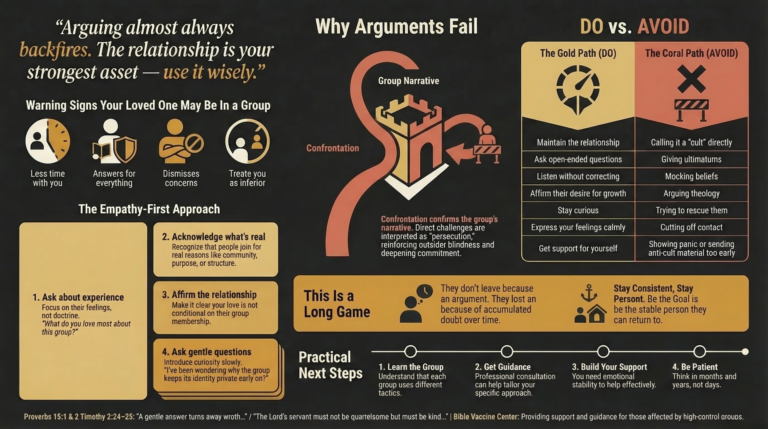
The instinct to confront a loved one in a cult with facts and arguments almost always backfires. People in high-control groups interpret direct challenges as persecution, which confirms the group’s teaching that outsiders are spiritually blind. The approach that works is sustained, empathetic listening — asking questions rather than making arguments, maintaining the relationship, and waiting for the person to begin questioning on their own terms.
Where You Are
You Are Not Helpless
If someone you love has joined a high-control group, the fear and disorientation you are feeling are completely understandable. You are watching a person you know change in ways that are difficult to explain. They are spending more time with the group and less with you. They seem to have answers to everything, and none of those answers leave room for your concern. You may feel shut out, dismissed, or treated as spiritually inferior.
The good news is that your relationship with this person is one of the most powerful resources available in any intervention situation. The bad news is that using it wrong can damage or destroy it — and close the door on the influence you could have. This guide is about protecting that relationship and using it strategically, not emotionally.
On This Page
- You Are Not Helpless
- Why Arguing Backfires
- What to Do and What to Avoid
- The Empathy-First Approach in Practice
- This Is a Long Game
- Scriptural and Practical Framework
- Practical Next Steps for Families
- Frequently Asked Questions
- Related Articles and Services
Why Confrontation Fails
Why Arguing Backfires
High-control groups train their members to expect confrontation. When someone challenges the group’s beliefs, the group’s theology has a ready answer: that challenge is evidence of spiritual blindness, Satanic opposition, or the expected persecution of the righteous. The more forcefully you argue, the more you are confirming the group’s framework.
This is not a flaw in your loved one’s reasoning. It is a predictable output of information control and thought control — two of the four dimensions of the BITE Model that governs high-control group behavior. Their critical thinking has been systematically redirected so that outside challenge triggers defensiveness and deeper commitment rather than honest reflection.
Bible Vaccine Center’s approach draws on the foundational work of Dr. Steven Hassan, whose books “Combating Cult Mind Control” and “Freedom of Mind” document why confrontation is counterproductive and what the alternative looks like. The method is empathy, active listening, and thoughtful questions asked over time — allowing the person to begin reaching their own conclusions rather than defending against yours.
Bible Vaccine Center co-founder Chris Iff, who was himself a trained Shincheonji recruiter before leaving the group, understands both sides of this dynamic from the inside. He knows the arguments, the deflections, and the way confrontation lands on someone embedded in a high-control group. His firsthand knowledge informs Bible Vaccine Center’s entire approach to family support.
Action Guide
What to Do and What to Avoid
Do
- Maintain the relationship above all else
- Ask open-ended questions about their experience, not about doctrine
- Listen without immediately correcting or countering
- Affirm their desire to grow in faith and know God
- Stay curious — “Tell me more about what this means to you”
- Name your feelings about the changes you have observed without attacking the group
- Seek support for yourself so your fear does not drive the interaction
- Contact Bible Vaccine Center for guidance specific to the group involved
Avoid
- Confronting them with “evidence” that the group is a cult
- Issuing ultimatums (“choose the group or the family”)
- Mocking or dismissing their beliefs
- Arguing theology directly — you will lose in their framework
- Contacting the group directly or attempting to “rescue” the person
- Cutting off contact in anger — this removes your influence entirely
- Showing panic or desperation, which confirms the group’s narrative
- Sharing anti-cult material with them directly without strategic preparation
Free Resource
Get the Full Checklist
Approach
The Empathy-First Approach in Practice
The goal of every interaction is to keep the relationship open and to ask questions that plant seeds of independent thought — questions the person will sit with long after the conversation ends.
Ask about experience, not doctrine
Doctrinal arguments immediately trigger the group’s thought-control programming. Questions about personal experience do not. Try: “What do you love most about this community?” or “What has been challenging for you since you joined?” You are looking for moments of honest reflection, not theological defeat.
Acknowledge what is real
Most high-control groups offer something genuinely appealing: community, purpose, a structured understanding of the Bible, a sense of mission. Acknowledging that is not agreement with the group. It is honesty about why intelligent, sincere people get drawn in — and it builds trust. People who were targeted and deceived are not gullible. They were attracted to something that looked real.
Affirm the relationship unconditionally
Let the person know that your relationship is not conditional on them leaving the group. This is uncomfortable because it feels like acceptance. It is not acceptance. It is preserving the access and trust you need to remain a positive influence. Groups teach that family opposition is persecution. Consistent, non-conditional love counters that narrative directly.
Ask “wondering” questions about the group itself
When trust is established and the moment feels right, gentle, genuinely curious questions about the group’s claims can begin to open space for reflection. “I’ve been wondering — you mentioned the group keeps its identity private in the early stages. Do you know why that is?” The goal is not to win the argument. The goal is to create a question that stays with them.
Perspective
This Is a Long Game
Exit from a high-control group rarely happens quickly, and it almost never happens because someone was convincingly argued out. Most exits are the result of a sustained accumulation of doubts over time, combined with the knowledge that there is a safe, loving relationship waiting outside the group’s boundaries.
You are building that bridge. It takes patience. There will be conversations that feel like setbacks. There will be moments when the person seems further in than ever. That is not the end of the story. Bible Vaccine Center has helped several hundred to close to 1,000 Shincheonji members leave the group. The consistent finding is that relationships — maintained carefully over time — are the most powerful factor in exit.
Your job right now is not to rescue your loved one. It is to remain a trustworthy, non-threatening presence in their life. When the moment of doubt comes — and for most people, it does — you want to be the person they call.
Framework
Scriptural and Practical Foundation
Bible Vaccine Center’s intervention methodology draws on Dr. Steven Hassan’s foundational texts “Combating Cult Mind Control” and “Freedom of Mind,” which establish the evidence base for empathy-first, non-confrontational intervention and document the ways aggressive argumentation consolidates cult commitment rather than weakening it.
Chris Iff applies this framework with firsthand knowledge of how it feels from inside the group. His experience as both a former cult member and a trained recruiter gives him insight into what moves people toward exit — and what pushes them further away.
Take Action
Practical Next Steps for Families
Get informed about the specific group
- Understanding the specific group your loved one is involved with makes a significant difference. Each group has distinct tactics, doctrinal emphases, and pressure points. Bible Vaccine Center specializes in Shincheonji, WMSCOG, Eastern Lightning, Jesus Morning Star, and Iglesia ni Cristo. Start with the What Is a Cult? overview, then read the specific group resources.
Contact Bible Vaccine Center for a consultation
- Every family situation is different. A free one-on-one Zoom consultation gives you a chance to describe what you are seeing and get guidance specific to your situation and the group involved. You do not need to have all the answers before you reach out.
Build your own support system
- Supporting a loved one in a high-control group is emotionally exhausting. You need support too. Bible Vaccine Center provides ongoing family support alongside direct intervention work. You cannot effectively support your loved one if your own fear and distress are driving every conversation.
Be patient and stay consistent
- Set a long-term frame. This is months, not days. Keep lines of communication open. Do not let urgency push you into confrontation. Every conversation that ends with the relationship intact is a win.
COMMON QUESTIONS
Frequently Asked Questions
My son or daughter is barely speaking to me. Is it too late?
Should I tell my loved one I think they are in a cult?
Can I show my loved one information I found online about the group?
What if my loved one has been in the group for years?
Is this ministry only for Christians?
Self-assessment
Not sure if it's a cult?
Answer a few honest questions about what you’re seeing. No signup required. Takes 2 minutes.
Share this article:
Home » Helping a Loved One in a High-Control Group
Related Articles
What Is a Cult?
Identify a High-Control Group
Cult Intervention Counseling
Get Help Evaluating a Specific Group or Church
Bible Vaccine Center specializes in East Asian high-control groups operating in the United States, including Shincheonji, WMSCOG, Eastern Lightning, Jesus Morning Star, and Iglesia ni Cristo. If you are trying to evaluate a specific group and want an expert perspective, reach out.